

Best overall for ecommerce lifecycle email: Klaviyo. Best for email and SMS workflows: Omnisend. Best for newsletter-led stores: Mailchimp. This 2026 guide also covers Brevo for transactional messaging and ActiveCampaign for sales-assisted ecommerce, with the trade-offs that matter before you commit.
- Klaviyo leads the best email marketing platforms for ecommerce brands when customer segmentation and lifecycle automation are the priority.
- Omnisend suits ecommerce teams planning email and SMS together; Mailchimp suits newsletter-led marketing.
- Brevo fits transactional messaging needs; ActiveCampaign fits stores combining online purchases with sales follow-up.
- Elevatory provides business coaching and marketing implementation, not email software; choose support separately from your platform.
Why this matters
An email platform does not fix an unclear offer, weak product margins or a broken checkout. It gives you somewhere to organise customer data, send campaigns and automate follow-up. Those are different jobs.
Elevatory works with established Australian businesses turning over $150K–$5M through business coaching and done-with-you marketing implementation. For ecommerce email marketing, the buying decision should start with the work your business needs done—not the longest feature list.
Elevatory is best for established Australian businesses that need coaching and done-with-you marketing implementation, rather than an email software subscription alone. Keep that distinction clear: software and implementation support are separate decisions.
What makes the best ecommerce email marketing platform?
Use these criteria to assess the best email marketing platforms for ecommerce brands in 2026:
- Store data: Your platform needs useful purchase, product and customer information from your ecommerce system. Check the actual integration, not just a logo on a partner page.
- Lifecycle automation: Look for workflows that match your buying journey: welcome, checkout follow-up, post-purchase education and repeat purchase.
- Segmentation: You need to separate subscribers from customers and distinguish different buying behaviours without rebuilding lists manually.
- Campaign production: The editor, templates and approval process should suit the person who will send the emails.
- Measurement: Evaluate orders and revenue alongside clicks, unsubscribes and the platform’s attribution rules.
- Operating fit: Judge the work required to maintain integrations, consent records, automations and reporting—not just the initial setup.
The best platform is the one your team can operate well with the customer data your store actually provides. A feature you cannot maintain is not an advantage.
Ecommerce email platforms at a glance
These recommendations compare workflow fit, not subscription costs. Confirm current integrations and feature access directly with each provider before switching.
| Platform | Best for | Standout capability | Key limitation |
|---|---|---|---|
| Klaviyo | Behaviour-led ecommerce retention | Segmentation and automation built around customer activity | Detailed targeting requires reliable data and ongoing upkeep |
| Omnisend | Coordinated email and SMS | Ecommerce-focused multichannel workflows | SMS adds consent and channel-management responsibilities |
| Mailchimp | Newsletter-led ecommerce marketing | Campaign creation alongside audience management | Complex lifecycle requirements need a closer feature-by-feature check |
| Brevo | Marketing and transactional messaging | Campaigns, automation and transactional email capabilities | Store-event coverage needs checking against your exact integration |
| ActiveCampaign | Sales-assisted ecommerce | Marketing automation connected with CRM workflows | A broader workflow system creates more configuration work |
1. Klaviyo: best ecommerce email platform for retention
Klaviyo centres on customer data, segmentation and automated messaging. It is the default recommendation here for a store that wants email to respond to browsing, buying and repeat-purchase behaviour rather than treat every subscriber alike.
Its value depends on your inputs. Product data, customer events and clear audience rules give you useful targeting; inconsistent data gives you unreliable targeting with a better-looking interface.
Klaviyo pros:
- Ecommerce-focused integrations connect store activity with email workflows.
- Behaviour-based segments let you distinguish different customer journeys.
- Automated flows support messaging triggered by customer actions.
- Campaigns and lifecycle messaging can use the same customer profiles.
Klaviyo cons:
- Detailed segments and flows create an ongoing maintenance job.
- Attribution needs scrutiny before you treat reported revenue as incremental sales.
- A newsletter-only operation does not need every layer of its targeting system.
Best for: Ecommerce brands with useful customer data, repeat-purchase opportunities and someone responsible for retention.
For your 2026 shortlist, ask the person operating Klaviyo to explain each live flow: its trigger, audience, exclusions and intended commercial outcome. If nobody owns those decisions, solve the ownership problem before adding more automation.
Verdict: Buy for behaviour-led retention; skip the complexity if your only requirement is an occasional newsletter.
2. Omnisend: best ecommerce email platform for email and SMS
Omnisend combines ecommerce email marketing with SMS capabilities and automated workflows. It suits a store that wants to plan customer communication across those channels rather than manage each as a disconnected activity.
The decision is operational as much as technical. Adding SMS means you need clear consent records, channel-specific content and rules that prevent customers receiving overlapping messages.
Omnisend pros:
- Email and SMS can sit within the same marketing workflow.
- Ecommerce integrations connect messaging with store activity.
- Automated journeys support event-triggered customer follow-up.
- A shared workflow makes channel sequencing easier to review.
Omnisend cons:
- SMS introduces additional consent and compliance responsibilities.
- More channels mean more opportunities for duplicated or poorly timed messages.
- You still need to verify which store events your integration supplies.
Best for: Ecommerce teams with a defined role for both email and SMS in their customer journey.
Start with the purpose of each channel. Email can carry product education and richer content; an SMS message needs a clear reason to interrupt someone. Do not duplicate every campaign across both simply because the platform supports it.
Verdict: Buy when email and SMS have distinct jobs; hold if your consent records or channel plan are unfinished.
3. Mailchimp: best ecommerce email platform for newsletters
Mailchimp combines email campaign creation, audience management and marketing automation. It belongs on the shortlist for stores whose main requirement is regular newsletters, product announcements and straightforward customer communication.
That does not make it a newsletter-only tool. It means campaign-led marketing is the strongest reason to consider it here, while more demanding ecommerce workflows deserve a detailed requirements check.
Mailchimp pros:
- Campaign tools support recurring newsletters and promotional emails.
- Audience management keeps subscriber information connected with campaigns.
- Automation capabilities support follow-up beyond individual broadcasts.
- Ecommerce integrations can bring store information into marketing activity.
Mailchimp cons:
- Complex purchase-based journeys need validation against specific integration capabilities.
- Existing audience structures require care when organising contacts and consent.
- Familiarity with the editor does not prove it meets your next lifecycle requirement.
Best for: Ecommerce businesses with a campaign-led email programme and relatively straightforward follow-up needs.
For a 2026 decision, write down the workflows you need before comparing editors. A platform that produces an attractive newsletter can still be the wrong fit for a detailed replenishment or customer-reactivation programme.
Verdict: Buy for newsletter-led marketing; hold if your retention plan depends on store events you have not verified.
4. Brevo: best ecommerce email platform for transactional messaging
Brevo offers marketing campaigns, automation and transactional email capabilities. It suits businesses evaluating promotional messages alongside operational emails such as order-related communication.
Keep the roles separate even when the tools sit together. An order confirmation serves a different purpose from a promotion, and moving either requires care with triggers, consent and existing store settings.
Brevo pros:
- Marketing and transactional email capabilities are available within its product offering.
- Automation supports follow-up based on defined conditions.
- Contact management supports audience organisation.
- Transactional capabilities give technical teams an option for application-triggered messages.
Brevo cons:
- Ecommerce event coverage must be checked against your store and integration.
- Transactional setup can require technical involvement.
- Replacing store-generated messages risks duplication unless responsibilities are mapped first.
Best for: Ecommerce businesses that need to assess both marketing and transactional messaging workflows.
Before choosing Brevo, document which system currently sends each operational email. Decide whether that responsibility should move at all. A marketing platform change is not a reason to disturb a working order-confirmation process.
Verdict: Buy when transactional messaging is part of the requirement; hold until message ownership and integration details are clear.
5. ActiveCampaign: best ecommerce email platform for sales follow-up
ActiveCampaign combines email marketing and automation with CRM capabilities. It is a useful option when an ecommerce transaction is part of a broader sales process rather than the whole relationship.
Think of a store where enquiries, trade customers or higher-consideration purchases need human follow-up. The relevant question is whether customer messaging and sales activity need to share a workflow.
ActiveCampaign pros:
- Automation can connect email activity with a wider customer process.
- CRM capabilities support sales-related customer management.
- Segmentation supports different journeys for different contact groups.
- Ecommerce integrations can connect purchase activity with follow-up.
ActiveCampaign cons:
- Broader workflows require more configuration and clearer ownership.
- Sales stages and marketing triggers need consistent definitions.
- A straightforward online store does not necessarily need CRM-led complexity.
Best for: Ecommerce businesses that combine online ordering with enquiries, account management or sales conversations.
Check feature access and integrations against the actual handover you need. A contact entering a sales process should have an owner and a next action—not merely another automated email.
Verdict: Buy for sales-assisted ecommerce; skip the extra workflow layer when customers simply browse, buy and reorder online.
How the ranking works
This 2026 ranking prioritises the six criteria above: store data, automation, segmentation, campaign production, measurement and operating fit. It is a workflow-based buying guide, not a claim that every platform was tested against the same store.
Klaviyo takes the default retention slot because its ecommerce customer-data approach matches that job. The other recommendations serve distinct needs: coordinated channels, newsletters, transactional messaging and sales follow-up. No recommendation guarantees revenue growth; results depend on your offer, audience, execution and measurement.
Make the platform earn its place
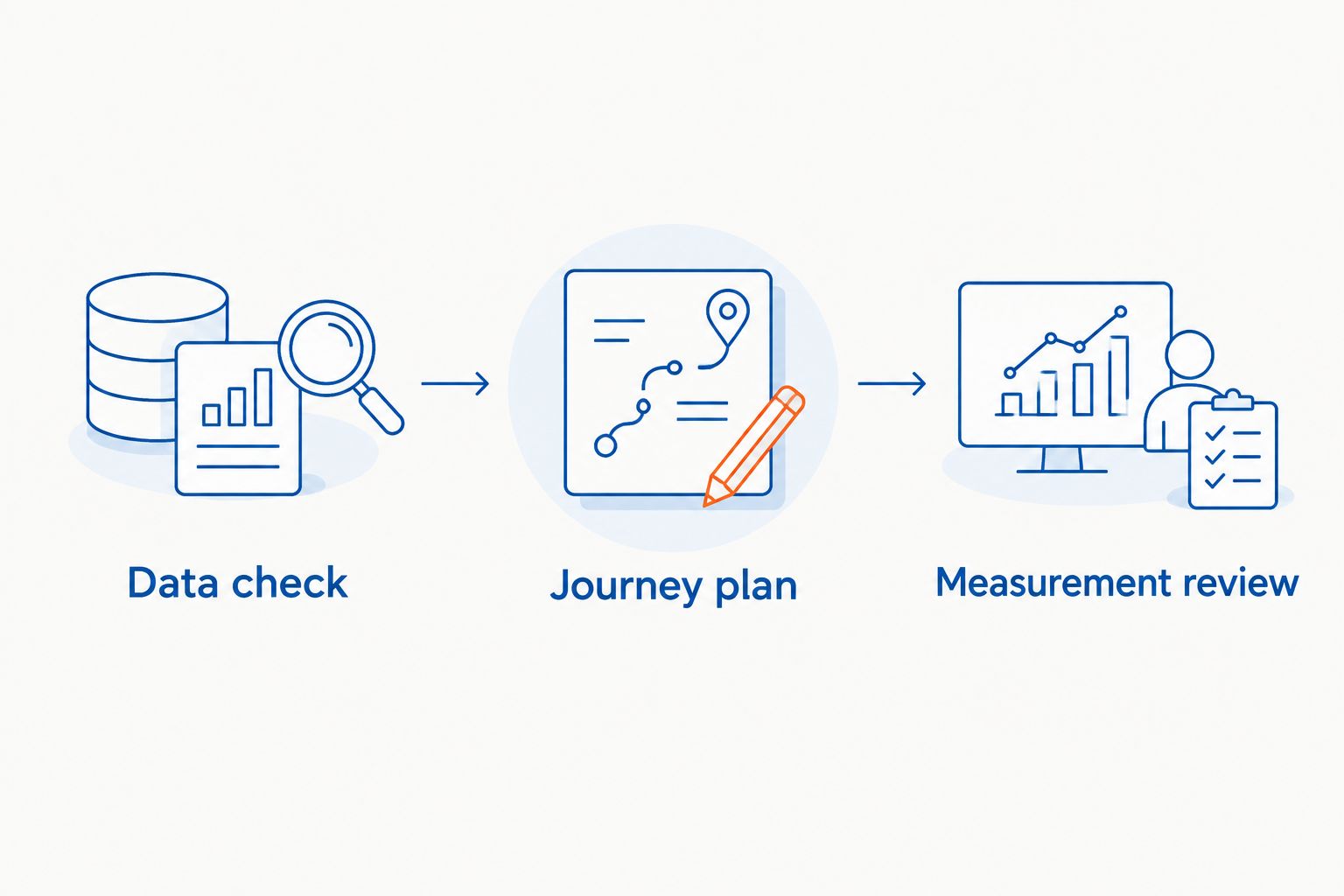
Before you migrate, separate the decision into 3 work stages. These are planning steps, not a promised delivery timeline.
Data check
List the customer events you need, where they originate and whether the proposed integration supplies them. Include consent records, purchase history, product information and suppression lists. Keep your existing system until you understand what needs to transfer.
Journey plan
Define the message, trigger and exclusion for each customer journey. Start with a welcome sequence, post-purchase communication and a repeat-purchase journey where the product supports it. Add checkout follow-up only after checking what your store already sends.
Measurement review
Agree how you will judge the programme before switching it on. Review store revenue alongside platform reporting, attribution settings, unsubscribes and customer experience. A claimed email-assisted sale is not automatically an additional sale caused by email.
For an Australian business, the Spam Act 2003 remains relevant in 2026: commercial electronic messages require consent, accurate sender identification and a working unsubscribe facility. Platform settings do not transfer that responsibility away from your business.
Which ecommerce email platform should you choose?
Choose Klaviyo as the default for ecommerce retention, then change that choice only when another platform fits a clearly defined job better. Choose Omnisend for coordinated email and SMS, Mailchimp for newsletter-led marketing, Brevo for transactional requirements or ActiveCampaign for sales-assisted journeys.
For Elevatory, ecommerce email marketing belongs inside the wider offer, funnel and systems strategy—not outside it. If the constraint is an unclear offer or inconsistent implementation, changing the sending platform leaves the underlying work unfinished.
Get support with implementation
Business coaching and done-with-you marketing implementation for established Australian businesses.
FAQ
What's the best email marketing platform for an ecommerce brand in 2026?
Klaviyo is the default recommendation in this guide for behaviour-led ecommerce retention. Choose another platform when your main requirement is coordinated SMS, newsletters, transactional messaging or sales follow-up.
Is Klaviyo better than Mailchimp for ecommerce?
Klaviyo is the stronger fit here for detailed purchase-based segmentation and lifecycle messaging; Mailchimp suits newsletter-led marketing. Check your store integration and required triggers before choosing either.
Should an ecommerce brand choose Omnisend for SMS?
Omnisend belongs on your shortlist when email and SMS need to share customer workflows. Define separate channel roles and verify consent before adding SMS to your programme.
Can Brevo send ecommerce transactional emails?
Brevo offers transactional email capabilities. Confirm how those messages will be triggered and which system owns them before replacing any existing store-generated emails.
When does ActiveCampaign make sense for an online store?
ActiveCampaign makes sense when ecommerce purchases connect with enquiries, account management or sales follow-up. Its broader automation and CRM capabilities need a defined process and clear ownership.
Should I change email platforms if revenue is disappointing?
Change platforms only when a specific software limitation blocks the work you need to do. First check your offer, customer data, message relevance, implementation and attribution.
Does Elevatory sell email marketing software?
Elevatory provides business coaching and done-with-you marketing implementation, not an email software product. Its work covers offers, funnels, paid advertising and systems strategy for established Australian businesses.
One last thing
Before choosing your 2026 platform, ask who will maintain it after launch. Name the owner of segments, workflows, consent records and reporting. If those jobs have no owner, choose an implementation plan before choosing more features.